
What Is Inventory and Supply Chain Management?
Inventory management is the discipline of controlling what a business has in stock, where it is located, how fast it moves, how much it costs, and when it should be replenished. 
Supply chain management is the broader discipline that connects inventory to suppliers, purchasing, logistics, warehouses, branches, sales channels, delivery cycles, and customer demand.
The two are inseparable.
Inventory is not just “products on shelves.” It is money in physical form. It is cash converted into goods, waiting either to become revenue or to become loss. Every item in stock carries a business question: Was it bought at the right time? In the right quantity? At the right cost? For the right demand? Is it moving fast enough? Is it tying up capital? Is it protecting sales, or quietly damaging cash flow?
A good inventory system does not simply count items. It reveals the behavior of the business.
It shows what sells, what sleeps, what disappears, what expires, what drains capital, what creates margin, and what customers actually demand rather than what the company assumes they demand.
Why Inventory and Supply Chain Management Matter
For retail and distribution companies, inventory is often one of the largest uses of capital. Poor control does not usually appear as one dramatic disaster. It appears as scattered symptoms: too much stock in one branch, stockouts in another, slow-moving items filling shelves, urgent purchases at bad prices, expired or obsolete goods, poor supplier discipline, unclear warehouse balances, weak purchasing decisions, and cash flow pressure that nobody can explain clearly.
Strong inventory and supply chain management improves three things at the same time: availability, profitability, and control.
Availability means the company can provide the right products when customers need them. Profitability means stock decisions support margin rather than destroy it. Control means management can see what is happening before problems become expensive.
This is why inventory management is not a back-office issue. It is a strategic function. It affects sales, cash flow, customer satisfaction, supplier negotiations, expansion, branch performance, pricing, and operational discipline.
A business that does not understand its inventory does not fully understand itself.
The Most Important Inventory KPIs
1. Inventory Turnover
Inventory turnover measures how many times inventory is sold and replaced during a period.
A high turnover usually means products are moving efficiently and capital is not trapped for too long. A very low turnover may indicate overstocking, weak demand, poor purchasing, obsolete items, or incorrect product mix. However, turnover must be interpreted by category. Fast-moving consumer goods, pharmaceuticals, spare parts, seasonal items, luxury products, and industrial goods do not behave the same way.
The value of inventory turnover is not only in the number. The value is in the comparison: by branch, category, supplier, season, and product family. A company may look healthy overall while hiding dead stock inside specific categories.
2. Days Inventory Outstanding
Days Inventory Outstanding, often called DIO, estimates how many days inventory stays in the business before being sold.
If DIO is too high, capital is sleeping inside warehouses and shelves. If it is too low, the company may be operating dangerously close to stockouts. The target depends on the industry, supplier lead times, demand volatility, and the cost of losing sales. 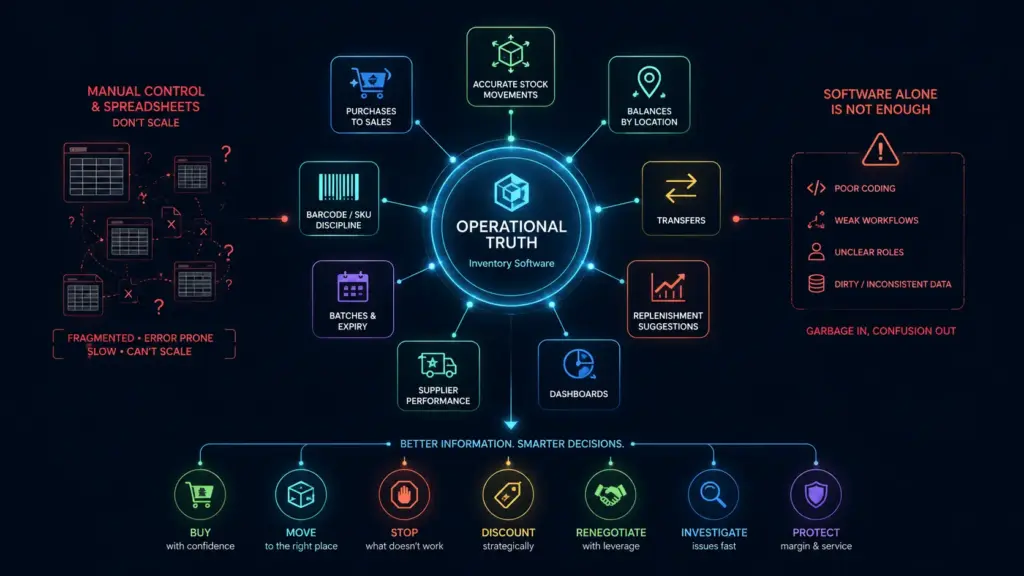
DIO is especially useful for management because it translates inventory into time. Instead of saying, “We have too much stock,” the business can say, “This category holds 120 days of inventory while the target is 45 days.” That is a more precise and actionable statement.
3. Stockout Rate
Stockout rate measures how often products are unavailable when they are needed.
This is one of the most commercially painful inventory problems because the cost is often invisible. A stockout does not only mean a lost sale. It may mean a lost customer, a damaged reputation, weaker branch performance, and reduced trust in the business.
Stockouts are not always caused by low inventory. They may result from poor forecasting, inaccurate balances, slow purchasing approvals, supplier delays, weak warehouse transfer systems, or bad allocation between locations.
A serious inventory system should not only record stockouts. It should explain why they happened.
4. Carrying Cost of Inventory
Carrying cost measures the cost of holding inventory. This may include storage, insurance, handling, financing cost, shrinkage, expiry, obsolescence, damage, and the opportunity cost of capital.
Many companies underestimate carrying cost because they look only at purchase price. But inventory consumes space, attention, labor, cash, and risk capacity.
A product may look profitable on paper while becoming unattractive after holding costs are considered. This is especially important for slow-moving items, bulky goods, seasonal products, perishables, and products with expiration dates.
5. Gross Margin Return on Inventory Investment
Gross Margin Return on Inventory Investment, or GMROI, measures how much gross margin the business generates for every dollar invested in inventory.
This KPI is powerful because it links stock to profitability, not only movement. A fast-moving item with weak margin may not be as valuable as expected. A slower-moving item with strong margin may still be useful if it does not damage cash flow or storage capacity.
GMROI helps management avoid a common mistake: treating sales volume as the main indicator of success. Sales matter, but inventory should be judged by the return it creates on the capital it occupies.
6. Inventory Accuracy
Inventory accuracy compares the stock recorded in the system with the actual physical stock.
Low inventory accuracy damages almost every decision. Purchasing becomes unreliable. Sales teams promise products that are not available. Warehouses waste time searching. Branch transfers become confused. Financial reports become distorted.
Inventory accuracy is not only a warehouse issue. It reflects the quality of the company’s processes: receiving, issuing, transferring, selling, returning, adjusting, counting, and documenting.
A system that shows false numbers is worse than no system, because it creates confidence without reality.
7. Shrinkage Rate
Shrinkage measures inventory loss caused by theft, damage, expiry, errors, undocumented movement, or unexplained disappearance.
Shrinkage is not always a fraud problem. Sometimes it is a process problem. Weak receiving, poor storage, unclear responsibilities, missing approvals, weak barcode control, unrecorded returns, and loose branch transfers can all create shrinkage.
The importance of shrinkage is not only financial. It is diagnostic. It tells management where control is weak.
8. Fill Rate
Fill rate measures the percentage of customer demand that can be fulfilled immediately from available stock.
This KPI is especially important for distribution companies and multi-location retail operations. A strong fill rate means the business can satisfy demand without delay. A weak fill rate means customers may wait, substitute, cancel, or leave.
Fill rate should be studied by product category, customer type, branch, warehouse, and supplier. Otherwise, the company may miss the operational cause behind poor service.
9. Lead Time
Lead time measures the time between placing an order and receiving the goods.
Long or unstable lead times force the business to hold more safety stock. Short and reliable lead times allow leaner inventory. Therefore, supplier reliability directly affects working capital.
Lead time should not be treated as a fixed number. It must be measured by supplier, product category, season, and route. The real risk is not only long lead time; it is unpredictable lead time.
10. Order Accuracy
Order accuracy measures whether the right items, quantities, prices, and conditions are delivered as expected.
Poor order accuracy creates hidden operational cost. Teams waste time correcting mistakes, customers receive wrong goods, returns increase, supplier disputes multiply, and inventory balances become unreliable.
This KPI is important because it connects purchasing, suppliers, warehouses, and customer service into one measurable chain.
Other Useful Inventory and Supply Chain KPIs
Sell-through rate measures the percentage of received inventory sold during a specific period.
Reorder point defines the stock level at which a new purchase or transfer should be triggered.
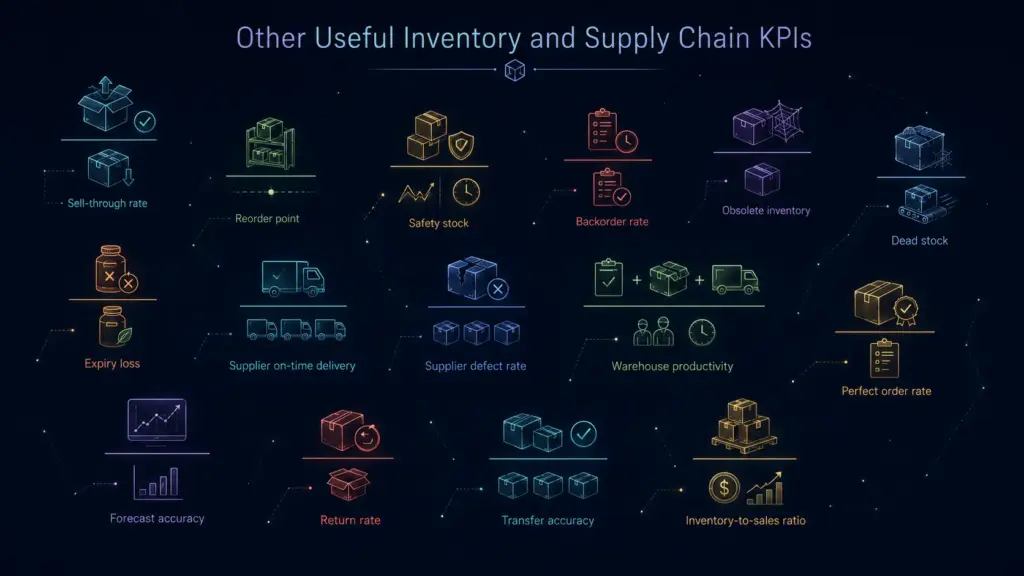
Safety stock measures the extra stock kept to protect against demand changes or supplier delays.
Backorder rate measures how often customer orders cannot be fulfilled immediately and must wait.
Obsolete inventory measures stock that is no longer sellable or commercially useful.
Dead stock measures items that have not moved for a defined period.
Expiry loss measures the value of products lost because they passed their usable or legal selling date.
Supplier on-time delivery measures how often suppliers deliver within the agreed timeframe.
Supplier defect rate measures the percentage of received goods that arrive damaged, incorrect, incomplete, or below standard.
Warehouse productivity measures how efficiently warehouse teams receive, pick, pack, transfer, and dispatch inventory.
Perfect order rate measures the percentage of orders delivered complete, accurate, on time, and without damage.
Transfer accuracy measures whether stock moved between branches or warehouses matches the recorded movement. Inventory-to-sales ratio compares inventory value to sales volume and helps detect overstocking or understocking trends.
Risks of Bad Inventory Management
Bad inventory management harms a business in ways that are sometimes obvious and sometimes silent.
The obvious risks include stockouts, expired products, damaged goods, missing items, overstocked warehouses, and delayed deliveries. These are visible problems.
The more dangerous risks are less visible. Cash becomes trapped in slow-moving products. Purchasing teams repeat old habits. Branches compete for stock without coordination. Sales teams lose trust in system balances. Managers make decisions based on inaccurate reports. Suppliers gain power because the company negotiates under pressure. Customers leave because availability is inconsistent.
Poor inventory management also distorts business planning. A company may believe it is profitable while cash flow is weak because inventory is absorbing liquidity. It may believe a branch is underperforming when the real problem is poor allocation. It may believe demand is low when the product was simply unavailable. It may believe purchasing is efficient because discounts were obtained, while the stock bought at a discount later becomes dead capital.
In weak inventory systems, the company does not only lose products. It loses visibility.
Why Good Inventory Software Matters
Inventory software is not valuable because it is digital. It is valuable if it creates reliable operational truth.
A good inventory system should record stock movements accurately, connect purchases to sales, show balances by location, support barcode or SKU discipline, manage transfers, track batches and expiry when needed, generate replenishment suggestions, monitor supplier performance, and provide useful dashboards for decision-makers.
For multi-location retail and distribution companies, software becomes essential because manual control cannot scale. Once branches, warehouses, suppliers, product variants, returns, transfers, and promotions multiply, spreadsheets become fragile. They may work temporarily, but they usually fail under operational pressure.
However, software alone does not solve inventory problems.
If item coding is messy, workflows are unclear, responsibilities are weak, and data entry is undisciplined, even the best software becomes a mirror of confusion. The system must be configured around the real business model, and the business must be disciplined enough to use it correctly.
The right software should not only answer, “How many items do we have?”
It should help answer, “What should we buy, move, stop, discount, renegotiate, investigate, or protect?”
How GlobalRise Can Help
GlobalRise Investment & Consulting LLC helps businesses approach inventory and supply chain management as a strategic, operational, and technical discipline.
At the strategic level, GlobalRise can help define the company’s inventory philosophy: what should be available, where it should be available, how much capital should be tied to stock, how inventory decisions affect cash flow, and how the supply chain supports growth, distribution, and customer experience.
At the tactical level, GlobalRise can help design better purchasing rules, branch replenishment methods, supplier follow-up routines, warehouse controls, product classification, stock review cycles, KPI dashboards, and inventory reporting protocols. The goal is to move from reactive stock handling to disciplined operational control.
At the technical level, GlobalRise can support the selection, improvement, or implementation of inventory management software. This may include reviewing current systems, improving SKU structures, defining workflows, preparing data-cleaning logic, designing dashboards, mapping reports, and helping teams use software as a decision tool rather than a passive database.
For retail, distribution, and multi-location businesses, inventory is not a small operational detail. It is one of the main engines of profitability, liquidity, and customer trust.
When inventory becomes visible, the business becomes more controllable.
And when the supply chain becomes disciplined, growth becomes less accidental.